GPT-6 Astra: 20 Real Examples From Useful to Almost Impossible
Discover 20 groundbreaking things GPT-6 Astra can do, from building 3D worlds and applications to controlling computers, analyzing data, automating workflows, testing software, and verifying complex tasks. Explore practical AI use cases, powerful automation capabilities, multi-agent workflows, AI-assisted writing, research, software development, and the emerging future of intelligent AI agents.
 Tamim
Tamim
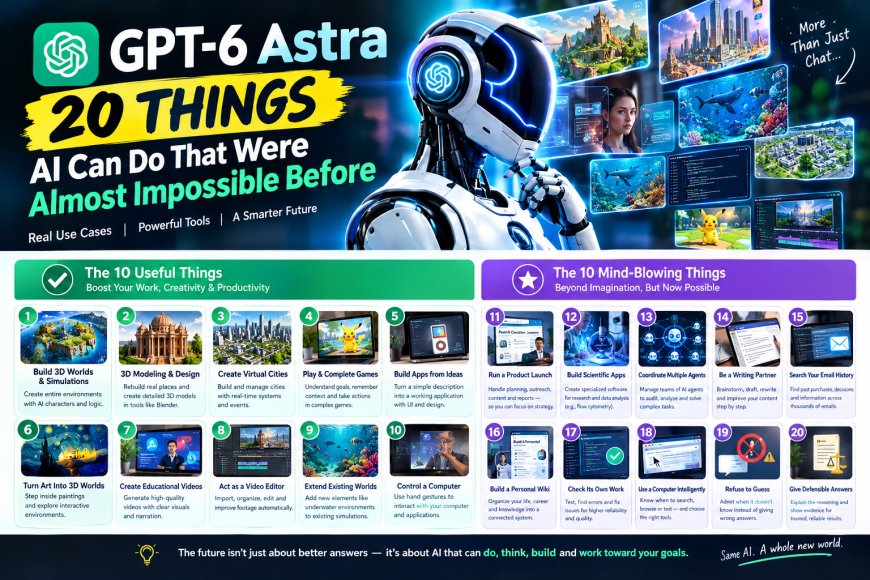
GPT-6 Astra: 20 Things AI Can Do That Were Almost Impossible Before
Something has changed in AI.
Not just another improvement in answering questions, writing code, or generating text.
A new generation of AI is beginning to do something much more interesting: it can interact with computers, understand enormous amounts of context, create complex digital environments, check its own work, and complete tasks that previously required teams of skilled people.
That is what makes GPT-6 Astra so fascinating.
Instead of simply asking, “How smart is this model?”, the better question is:
“What can I actually do with it now that I couldn't do before?”
Across hundreds of examples shared online, a remarkable pattern is emerging.
Some of these experiments are entertaining.
Others are genuinely useful.
And a few are difficult to believe until you see them working.
Here are some of the most interesting examples.
1. An Entire World With 600 AI Characters
Imagine creating an entire planet, filling it with villages and islands, and then placing 600 autonomous AI-controlled people inside it.
That is essentially what one developer did.
The characters could move around, communicate, make plans, and interact with their environment. They weren't simply following a predetermined script.
They were behaving more like inhabitants of a living world.
The truly remarkable part wasn't that AI characters could talk.
We've seen that before.
The astonishing part was that Astra helped create the 3D models, environment, map, and underlying logic that made the entire world possible.
A project that would traditionally require programmers, artists, game designers, and technical developers could now be approached through natural-language instructions.
2. Rebuilding Real Buildings in 3D
Astra is also demonstrating an impressive ability to work with 3D software.
One example recreated San Francisco's Palace of Fine Arts inside Blender.
This wasn't a picture pretending to be 3D.
It was an actual 3D model.
The architecture, shapes, structures, and details were generated inside a professional 3D environment.
This suggests that AI isn't simply learning how objects look.
It's increasingly learning how digital objects are constructed.
And that distinction is enormous.
3. Build Your Own Virtual City
Now take that idea one step further.
Instead of building one building, create an entire city.
One demonstration produced something resembling a playable version of SimCity.
You could designate areas for offices, construct towers, monitor healthcare, respond to police incidents, and watch the city evolve.
The impressive part wasn't one particular building.
It was the complexity of the system.
There were buildings, infrastructure, events, rules, and interactions happening inside one environment.
That level of interconnected digital simulation has traditionally required significant development effort.
AI is beginning to compress that process.
4. AI Can Now Play Pokémon
Here's an example that gives us a much easier benchmark to understand.
AI was asked to complete Pokémon.
Previous generations struggled enormously with this kind of long-running interactive task.
But newer models have been steadily improving.
According to the example in the transcript, earlier systems took many hours to complete the game, while Astra reportedly reduced the completion time dramatically.
The important point isn't really Pokémon.
It's what Pokémon represents.
A game requires an AI system to:
-
Understand its objective
-
Remember what happened earlier
-
Navigate an environment
-
Make decisions
-
Interact with interfaces
-
Adapt when something goes wrong
-
Continue working toward a long-term goal
That's much closer to a real-world task than simply answering a question.
5. Create an App From One Sentence
One of the most exciting demonstrations involved building a Mac application around a 3D iPod.
The instruction was essentially:
Create an app, build the iPod in Blender, reproduce its interface and interactions, and use it to display information.
Think about what that means.
A person doesn't necessarily have to start by opening a development environment, finding a 3D model, designing an interface, writing code, and connecting everything manually.
They can start with an idea.
“I want this.”
And AI can increasingly figure out the implementation.
That could eventually change how ordinary people build software.
6. Turn a Painting Into a 3D World
Here's a more creative experiment.
Take a Van Gogh painting.
Instead of simply displaying it on a screen, transform it into an explorable 3D environment.
Suddenly, the viewer can move through the world represented by the artwork.
The sunflowers aren't just pixels anymore.
They're part of a digital environment.
This opens an intriguing possibility for education, museums, games, storytelling, and interactive art.
7. Generate an Educational Video
Another demonstration asked AI to create a five-minute educational video about T-cells.
The result was surprisingly polished.
This matters because AI-generated video has existed for some time.
The problem has often been obvious artifacts:
-
Strange layouts
-
Inconsistent visuals
-
Awkward transitions
-
Incorrect information
-
Clearly artificial presentation
But as these systems become better at reasoning, design, and verification, the quality threshold changes.
Eventually, AI-generated content may become good enough that viewers don't immediately think:
“This was obviously made by AI.”
That's when adoption accelerates.
The Practical Revolution Begins
The previous examples are fascinating.
But the most important question is:
Can this actually help people do real work?
The answer appears to be increasingly yes.
8. AI as a Video Editor
One experiment gave AI access to Final Cut Pro and asked it to perform a relatively standard video-production workflow.
It imported files.
Organized them.
Synced recordings.
Adjusted colors.
Located different audio tracks.
And even selected the better audio track while removing unnecessary ones.
That last part is particularly interesting.
The AI wasn't simply following a rigid sequence of instructions.
It recognized an additional task that made sense within the workflow.
That's a major shift.
The future isn't necessarily about telling AI every tiny action.
It's about giving it an objective and allowing it to determine the steps required to reach that objective.
9. Build an Underwater World
Another experiment started with an existing procedural ocean and weather simulation.
The simulation already handled the world above the water.
The instruction to Astra was essentially:
Build everything underneath the sea.
And it generated an underwater environment.
Again, the specific example may not have an obvious everyday application.
But the underlying capability is important.
AI can take an existing digital system and extend it.
That's much more powerful than simply generating something from scratch.
10. Control a Computer With Your Hands
We've seen the science-fiction version of this in movies like Minority Report.
Someone points at a screen.
The computer responds.
One demonstration asked Astra to create a similar interface using hand gestures.
The user could point at objects, move the cursor, and use gestures such as pinching to interact with the computer.
One sentence.
No long development process.
No dozens of revisions.
Just an idea translated into a working interface.
What Happens When AI Gets Access to Your Information?
This is where things become even more interesting.
The next generation of AI isn't only becoming better at creating things.
It's becoming better at understanding your existing information.
And that may ultimately be more valuable.
11. AI Helps Run an Entire Product Launch
One particularly interesting example involved using AI to support the launch of an AI model itself.
The system handled tasks such as:
-
Maintaining spreadsheets
-
Updating communication plans
-
Drafting pitches
-
Tracking responses
-
Preparing press materials
-
Creating branded PDFs
-
Collecting assets
-
Monitoring online coverage
-
Analyzing social reactions
-
Preparing reports
Notice something important.
The human didn't disappear.
Instead, AI handled the repetitive operational work.
The human could spend more time on:
Strategy.
Communication.
Decision-making.
Relationships.
That's probably one of the most important patterns emerging from all these examples.
AI isn't necessarily replacing the entire job.
It may be replacing the parts of the job that prevent you from doing the highest-value work.
12. Build a Scientific Application
Another example involved a sophisticated scientific application for analyzing flow cytometry data.
Specialized software like this can traditionally cost laboratories thousands of dollars.
The experiment demonstrated that AI could produce a functional research-oriented application tailored to the user's requirements.
That's significant because it changes the economics of specialized software.
Instead of asking:
“Which software should I buy?”
People may increasingly ask:
“Can I build the exact software I need?”
13. Coordinate Dozens of AI Agents
Here's where things become even stranger.
Astra was reportedly used to coordinate 55 agents to audit financial models.
The task involved checking multiple financial workbooks, comparing calculations, identifying problems, and correcting issues.
This introduces an interesting concept:
AI doesn't necessarily have to work alone.
One AI can perform the task.
Other AIs can check the work.
Another can compare the results.
Another can search for inconsistencies.
The system becomes less like a chatbot and more like a digital organization of specialized workers.
14. AI as a Writing Partner
Writing remains one of the biggest everyday applications.
But the interesting part isn't simply asking AI:
“Write an article.”
The more powerful workflow is collaborative.
You write.
AI critiques.
You revise.
AI restructures.
You add your ideas.
AI helps organize them.
You decide what matters.
AI helps communicate it.
The best use of AI writing may therefore be less about replacing writers and more about making writers faster, clearer, and more capable.
15. Search Your Entire Email History
Imagine asking AI to analyze your entire email history.
Not one email.
Not ten emails.
Thousands of messages.
Then ask it to extract specific information.
One example used this approach to identify previously purchased SSDs and RAM, then compare their original prices with current market prices.
But the bigger idea is more interesting than the specific example.
Your email account contains a huge amount of hidden knowledge:
-
Purchases
-
Decisions
-
Projects
-
Conversations
-
Contacts
-
Commitments
-
Preferences
-
Historical information
AI can potentially turn that massive archive into something you can actually query.
16. Build a Personal Wiki From Your Life
Another experiment took this concept even further.
The AI was given access to a person's emails, writing, calendar information, and other records.
It then created a personal wiki containing information about their career and work history.
The idea is fascinating.
Instead of your knowledge being scattered across thousands of files, emails, and conversations, AI can organize it into a connected knowledge system.
Then that information can be used to help determine:
What should you pay attention to next?
In other words:
Your history becomes context for your future.
17. AI That Checks Its Own Work
One of the biggest weaknesses of AI has traditionally been reliability.
What happens if it makes a mistake?
That's why the ability to verify work may be more important than simply generating work.
Astra was reportedly used for quality assurance, opening websites, clicking buttons, sending messages, checking console errors, refreshing pages, and testing different user interactions.
Instead of simply building software, AI could also test the software it built.
That's a powerful feedback loop:
Build → Test → Find problems → Fix → Test again.
18. AI That Knows When to Use a Computer
There's another subtle but important improvement.
Previous AI systems often needed detailed instructions telling them when to open a browser, when to inspect something, and when to test their work.
Newer systems appear increasingly capable of recognizing:
“I should check this myself.”
That's a significant change.
It means the AI isn't simply executing instructions.
It's making decisions about which tools it needs to accomplish the objective.
19. AI That Refuses to Guess
Perhaps one of the most important changes is what happens when the AI doesn't have enough information.
Older systems often tried to be helpful by improvising.
And that's exactly how you lose trust.
You ask for something.
The AI gives you an answer.
It's wrong.
You correct it.
It apologizes.
Then it makes another mistake.
Eventually you stop believing it.
A more reliable system should be willing to say:
“I don't have enough information to continue.”
That may sound like a weakness.
It isn't.
Knowing when not to guess is a form of intelligence.
20. AI That Produces Defensible Answers
The final example brings everything together.
Consider a legal task.
AI is asked to review an NDA against a company's internal contracting policy.
Simply reaching the correct conclusion isn't enough.
It must also identify the specific provision that supports the decision.
That distinction matters.
A useful professional AI system doesn't just say:
“This contract should not be approved.”
It needs to explain:
“This contract should not be approved because this specific provision conflicts with this specific policy.”
Now the result becomes defensible.
And that may be the real breakthrough.
The Bigger Story
When you put all 20 examples together, a pattern appears.
AI isn't simply becoming better at generating answers.
It's becoming better at:
Understanding context.
Using computers.
Creating software.
Building environments.
Working with data.
Checking results.
Coordinating multiple agents.
Following complex instructions.
Knowing when information is insufficient.
And perhaps most importantly:
Working toward a goal instead of simply responding to a question.
That's a completely different category of capability.
What Does This Mean for You?
You don't need to build a virtual city.
You don't need 600 AI characters.
You don't need a research laboratory.
You don't even need to know how to code.
The important lesson is to look at the pattern behind the examples.
Ask yourself:
“What repetitive work do I do?”
“What information do I constantly search through?”
“What tasks require me to move between several applications?”
“What work do I repeatedly check?”
“What could I delegate if AI could actually use my computer?”
“What decisions could become easier if AI understood my entire work history?”
Those questions are much more valuable than simply asking:
“What cool thing can AI do?”
We're Entering a New AI Era
Yesterday, many of these capabilities felt unrealistic.
Today, they're becoming demonstrations.
Tomorrow, they may become ordinary workflows.
The exact killer applications are still being discovered.
That's what makes this moment so interesting.
We don't yet know exactly what this technology will become.
But we can already see the direction.
AI is moving from:
Answering questions → Doing tasks.
From:
Generating content → Building systems.
From:
Following instructions → Pursuing goals.
From:
Producing results → Checking and defending those results.
And that changes the role humans play.
The winning strategy probably isn't to compete with AI at everything.
It's to combine what AI does exceptionally well with what humans do exceptionally well.
AI brings speed, scale, computation, information processing, and increasingly powerful computer interaction.
Humans bring judgment, intuition, creativity, emotional intelligence, values, and purpose.
The future belongs to the combination.
The most interesting question isn't whether AI will change the world.
It already is.
The question is:
What will you do with it?